West Papua Antara Hukum Internasional
Kantor OPM Inggris Indonesia Protes
Tahanan Politik Papua
Tuntutan Kemerdekaan Rakyat Papua
West Papua Sebuah Pelanggaran Hukum Internasional
Indonesia Klaim terhadap kedaulatan atas Papua Barat bersandar pada dasar hukum yang tidak sehat dan Manipulasi Fakta...More
Terkait Kantor OPM Indonesia Belajar Dulu Sistem Pemerintah Inggris
Negara tidak harus protes dan menyampaikan keberatan secara keras kepada negara tertentu jika belum memahami sistem kenegaraan yang di anut setiap negara di duniaMore
Bebaskan Tahanan Politik Papua Tanpa Syarat
UK based NGO TAPOL Forcefully challenges the Indonesian Government Repeated Assertion that the Country has no Political Prisoners...More
Rakyat Papua Tuntut Kemerdekaan
Dalam Berbagai Aksi Damai Rakyat Papua Tuntut Hak Politik dan Kemerdekaan...More
Fiji menceritakan prestasi di bawah kepemimpinannya, menyerahkan kursi FMM untuk FLNKS
Categories :
FLNKS . Free West Papua . Freedom . Human Rights . Indonesia . Malanesia . MSG . Nasional
Fiji menceritakan prestasi di bawah kepemimpinannya, menyerahkan kursi FMM untuk FLNKS
Categories :
FLNKS . Free West Papua . Freedom . Human Rights . Indonesia . Malanesia . MSG . Nasional
Open letter from FWPC to Melanesian Spearhead Group (MSG)
Categories :
Asia Pasifik . Free West Papua . Human Rights . Indonesia . MSG . Politik . West Papua
TO:Independence Garden,
Port Vila, REPUBLIC OF VANUATU
West Papuans are undisputedly Melanesian and their people he same as everyone from Papua New Guinea, Solomon Islands, Vanuatu, New Caledonia (Kanaky) and Fiji.
Melanesia does not stop at a straight border.
During this tragedy, Papuans have suffered horrific human rights abuses, many of which are well documented with photo and video evidence and include countless reports of torture, rape, imprisonment with false evidence or without trial, and many more atrocities committed by Indonesian state military, police, security forces and intelligence at the express order of the Indonesian government.
It is estimated by many that if the Melanesian people are not given full self-determination within 20 years then the 2 million Melanesian people of West Papua will cease to exist anymore.
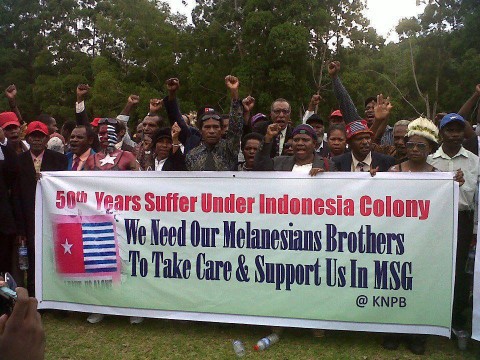
Papuans carry banners calling for their Melanesian brothers and sisters in MSG, as well as the leaders of the group and of Melanesian Nations, to support their cry for freedom and to welcome their country as into the Melanesian family of Nations as Kanaky, which also is not yet an independent nation, already has been.
West Papua, like Kanaky, is not yet an independent nation, and is currently like under the control of a colonial power like Kanaky is.
Why should this stop the people of West Papua from joining the Melanesian Spearhead Group?

I have been detained by Indonesian Police last month on May 13 on a peaceful rally where led in support the MSG and activists intimidated by Police. And again today May 10, KNPB mediate people of West Papua in whole regions are rallying and will continue to ask your support although peoples already been known that their body are going to be intimidate, shot dead, or arrest by Indonesian angry police and TNI. We could not let our people die and extinct from this Melanesian land under Indonesian colonial rule.
The peaceful rally is legal under Indonesian and International rule, but today, in open era, this is very difficult situation for us and people to freely expressing our felling, but this is the only one way for us to show our deepest hope to our Melanesian Brothers and Sisters especially you as Leaders to support us to be full member of MSG and to discuss our need to get independent as basic right of the self-determination under international law.
We are not slave nation nor animal on our own land. The people of West Papua are Melanesian, your people and your family. I am only local leader but for them you are their Melanesian leader. So, where they go and hope? where I have to lead and bring their tears of suffering if not you? And how much more the tears and bloods is going on? And how long do you keep in silent and forget us?
Melanesian Leaders, this is opportunity for you to take action in MSG. We have to defend and protect our land and the people strongly, more than economic and political benefit of colonial and capitalist.
Victor Yeimo
Chairperson of KNPB
Behind Indonesian Prison Bar
They will not be stopped by torture, imprisonment, death or genocide.
Their Melanesian Spirit is strong.
We are certain now that this time, the people of West Papua will not be forgotten by their loving Melanesian family in MSG.
We and the Melanesian people of West Papua pray and hope with all our hearts that the Melanesian Spearhead Group will welcome their Melanesian brothers and sisters in West Papua back into the family of the Melanesian nations and grant West Papua membership of MSG.
We are all Wantoks.
PO Box 656
Oxford
OX3 3AP
United Kingdom
Fax: +44 (0) 1865 403 217
Tomorrow Demo Support MSG in Biak While Prohibited Police
![]() |
| Photo ilst |
Indonesia denies it has any indigenous peoples
Categories :
Human Rights . Indonesia . Internasional . UN
![]() |
| Papuan |
Human rights-based housing policy urgent in Indonesia
Categories :
Conflict . Human Rights . Indonesia Timur . Nasional . SBY . UN
Question: Pundits and activists have criticized the country’s development policies as being unfavorable toward the poor and marginalized groups, yet the government and private entities seem deaf to the criticisms. What is their problem?
Answer: The main narrative of the government regards the urban poor [those living in informal settlements, working in the informal sector] as illegal not deserving of attention. Another narrative puts the blame on migration. [The authorities say] we should stop migration because it is impossible to provide adequate housing for the influx.
Those narratives are very discriminatory. Migrants and non-migrants are equally Indonesian. People would not migrate if there was no need to do it.
Despite the fact that nearly one in four urban residents has migrated from rural areas during their lifetime, many are still without identity cards and do not receive any public services.
Migrants are particularly vulnerable to the consequences of forced evictions. In the absence of ID cards, they are denied compensation or relocation [in many cases back to their place of origin]. Given the concentration of economic and employment opportunities in urban centers this solution is not sustainable,
Migrants are the engine of economic growth; they have transformed this country.
Discrimination is rife toward people living in places like riverbanks or railways. We have to take into consideration that nobody lives there as a matter of choice. We need to overcome the ways in which we see these problems.
It is common to see authorities turn to eviction-base development when dealing with slum improvement. Do you think this is a reflection of simple-minded officials?
No. The issue is what and who is urban development for? If you believe development should be for everyone, then you treat these issues in a different way. It is the obligation of the state to prioritize vulnerable and marginalized groups. It is time for Indonesia to come in line with human rights in this respect.
Forced evictions are a gross violation of human rights. Mass forced evictions may only be carried out under exceptional circumstances and in full accordance with international human rights law, which includes the obligation to provide full information on the purpose of the evictions; legal remedies and legal aid to those who are in need of seeking redress from courts.
A myriad of national, provincial and municipal laws and regulations allows local government to conduct evictions. Although the settlements are branded as “illegal squatting”, this term is misleading, for the derogatory term obscures the fact that the occupation took place with permission and/or tolerance from the state.
This eviction approach is a regression because the people are worse-off than before.
What about the kampung development program?
According to official estimates, 80 percent of housing development in Indonesia has been constructed through informal household based systems including self-help housing. While most houses produced by real estate corporations are targeted for speculative investments by the upper 10 percent of urban population.
I am concerned that as urban land becomes scarce and the prices skyrocket, innercity kampungs face the threat of powerful economic forces. The innercity kampung is an intrinsic part of urban history, central to the cultural and social fabric of society.
The government should service these kampungs with adequate infrastructure and public services, including redevelopment when required.
An important aspect in securing the existence of the kampung is ensuring a strong degree of security of tenure. [Spatial] planning should declare very clearly that the informal segment should be there forever and can be upgraded in accordance the right to adequate housing.
What will you say after assessing the issue of urban development here?
My report [to be presented to the Human Rights Council in March 2014] will be a kind of warning, saying: look, if we don’t address this it can become the source of conflict.
According to one study, 65 percent of administrative court cases involve land disputes, at the Law and Human Rights Ministry it is two out of three complaints and one of the top five complaints at the Ombudsman.
The coming years present a window of opportunity for Indonesia, which means either go radically in one direction and then have the problem of land conflict and housing or go in another direction toward a better future.
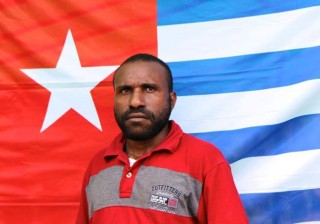
Global campaigner seeks freedom for West Papua
![]() |
| Benny Wenda |